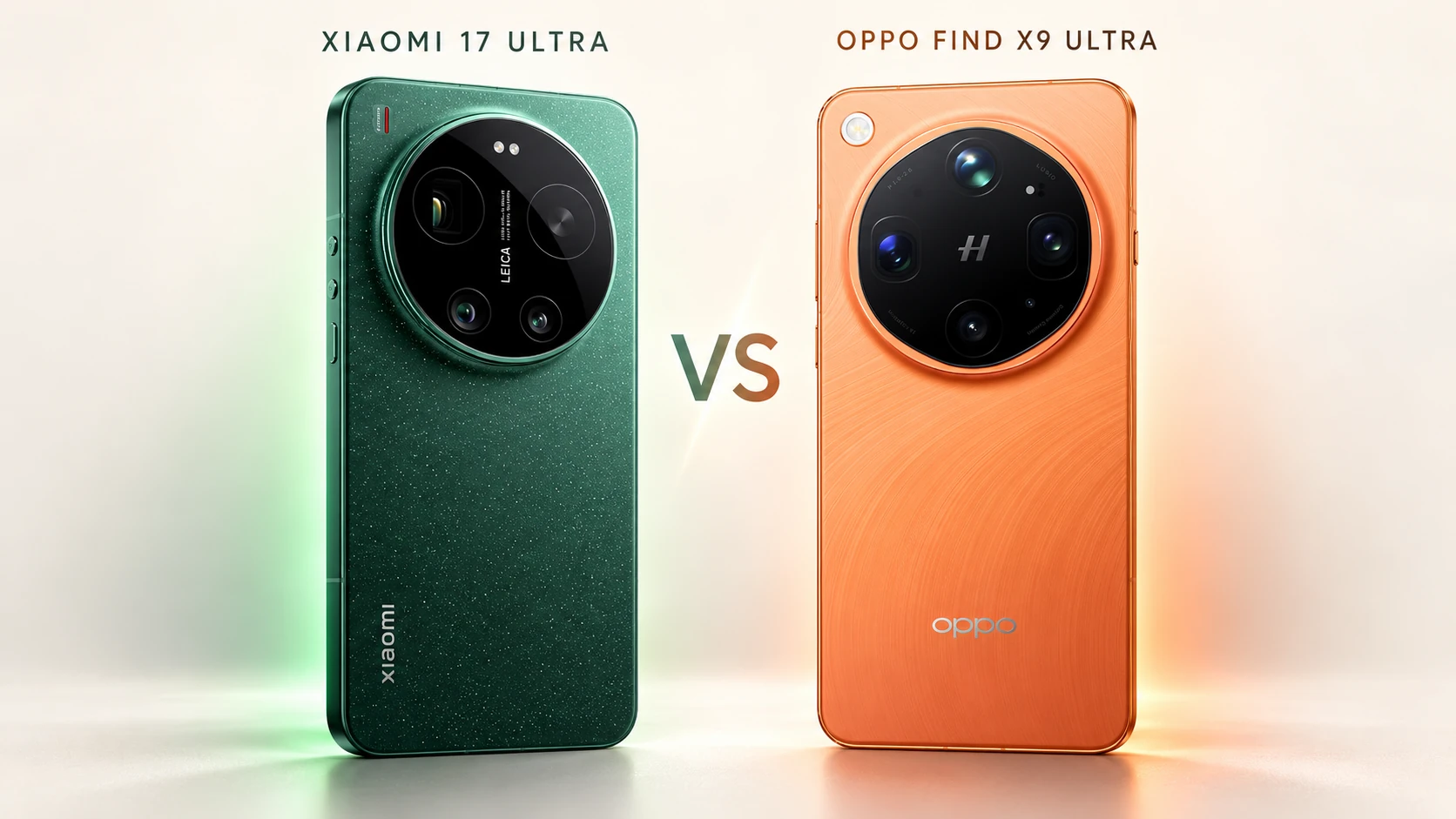
Updated October 28, 2026. Xiaomi 17 Ultra is the more interesting option for someone drawn to a 1-inch-type main sensor and a mechanically variable 75–100mm telephoto. OPPO Find X9 Ultra is the alternative to examine for longer native zoom and a larger published battery. The camera brands describe different approaches; they do not settle image quality on their own.
Quick comparison
| Feature | Xiaomi 17 Ultra (global) | OPPO Find X9 Ultra (global) |
|---|---|---|
| Processor | Snapdragon 8 Elite Gen 5 | Snapdragon 8 Elite Gen 5 |
| Main camera | 50MP; 1-inch-type sensor | 200MP; f/1.5 |
| Telephoto approach | 200MP; mechanical 75–100mm zoom | 200MP telephoto plus 50MP ultra telephoto; up to 10x optical zoom |
| Ultra-wide / selfie | 50MP / 50MP autofocus | 50MP / 50MP autofocus |
| Screen | 6.9-inch; 1–120Hz | 6.82-inch; 1–120Hz; 144Hz in some games |
| Typical battery | 6000mAh | 7050mAh |
| Charging maxima | 90W wired; 50W wireless | 100W wired; 50W wireless |
| Weight | 218.4–219g | 235–236g |
Camera choice: focal lengths are more useful than labels
Xiaomi’s variable telephoto spans a defined range of optical focal lengths. OPPO adds a separate longer-reach camera. For travel, think about what you photograph: people at a comfortable distance, building details across a street, or subjects far from your position.
Our interpretation is that Xiaomi deserves attention from photographers who often work within its variable optical range. OPPO deserves attention when distant framing is a frequent requirement. Neither approach guarantees better photographs at every zoom setting, especially once digital processing takes over.
An optical-quality crop is also different from a lens physically moving or a separate native telephoto. Compare the exact focal length and output resolution used in a sample. A maximum digital magnification figure says little about the photographs you would keep.
Main cameras: a different hardware tradeoff
Xiaomi emphasizes sensor size; OPPO emphasizes a higher main-camera pixel count. Neither number describes autofocus reliability, shutter timing, highlight handling or how a face looks indoors. Those are the sample comparisons that should decide a photography purchase.
For family use, request moving-subject examples rather than judging only static landscapes. Stabilization helps camera shake, while a person moving through the frame creates another problem. We have not tested either phone and therefore do not declare a winner for children, pets or night photography.
Size and handling: both have large camera modules
The Xiaomi global model is lighter on the published weights. OPPO’s grip and balance should be checked with the exact finish and case, because its rear material and body thickness vary. A prominent camera ring can change how a phone feels in landscape orientation.
Try reaching the shutter, changing zoom and holding the phone at arm’s length. If you use a photography kit or grip, compare the complete carrying weight and cost. Accessories are optional purchases and should not be confused with the standard phone.
Display and performance: read the mode restrictions
The shared processor family removes an easy chip-generation tie-breaker. Sustained gaming, camera processing and heat still depend on each implementation. A consistent long-session test would be more useful than assuming identical chips produce identical results.
OPPO’s highest listed refresh mode applies only in certain games. It should not be described as permanent system-wide behavior. For everyday use, compare text, reflections and motion at normal settings; for gaming, check support in your exact title.
Battery and charging: global specifications matter
OPPO has the larger listed typical capacity in this comparison. That is useful hardware headroom, not proof of a proportional endurance advantage. Camera recording, signal strength and screen settings can change consumption dramatically.
This article deliberately uses Xiaomi’s global battery figure. Import listings can describe another regional model, so confirm the model number before comparing deals. Both companies’ top charging speeds require compatible accessories, and OPPO specifies a lower adapter maximum in low-voltage areas.
Value: buy the camera behavior you need
Compare equal storage, warranty and local repair support before deciding that one brand is cheaper. A camera-centered phone is poor value if its size discourages you from carrying it. A short trial with the right case can be more revealing than another page of specifications.
For a fair camera check, shoot the same scene from the same position, then compare exposure, focus and detail at your usual viewing size. Keep automatic and edited results separate. The most useful winner is the phone whose photographs suit your subjects and workflow.
Which phone should you choose?
Choose Xiaomi 17 Ultra if its lighter body and variable 75–100mm optical range align with your photography. Its global charging and battery configuration should be matched to the unit on sale.
Choose OPPO Find X9 Ultra if a dedicated longer-reach camera and larger stated battery are the priorities. Verify image samples before interpreting that hardware advantage as a quality ranking.
Read the individual phone guides
Official sources
- Xiaomi official global specifications
- Xiaomi optical zoom and design details
- OPPO official global specifications
Method: This is an editorial comparison of published manufacturer specifications, not a hands-on test. Recommendations are our interpretation of the listed features; no benchmark, camera ranking or measured battery result is claimed. Regional models, accessories and software features can differ. The AI-created cover follows official device imagery and is an editorial illustration.