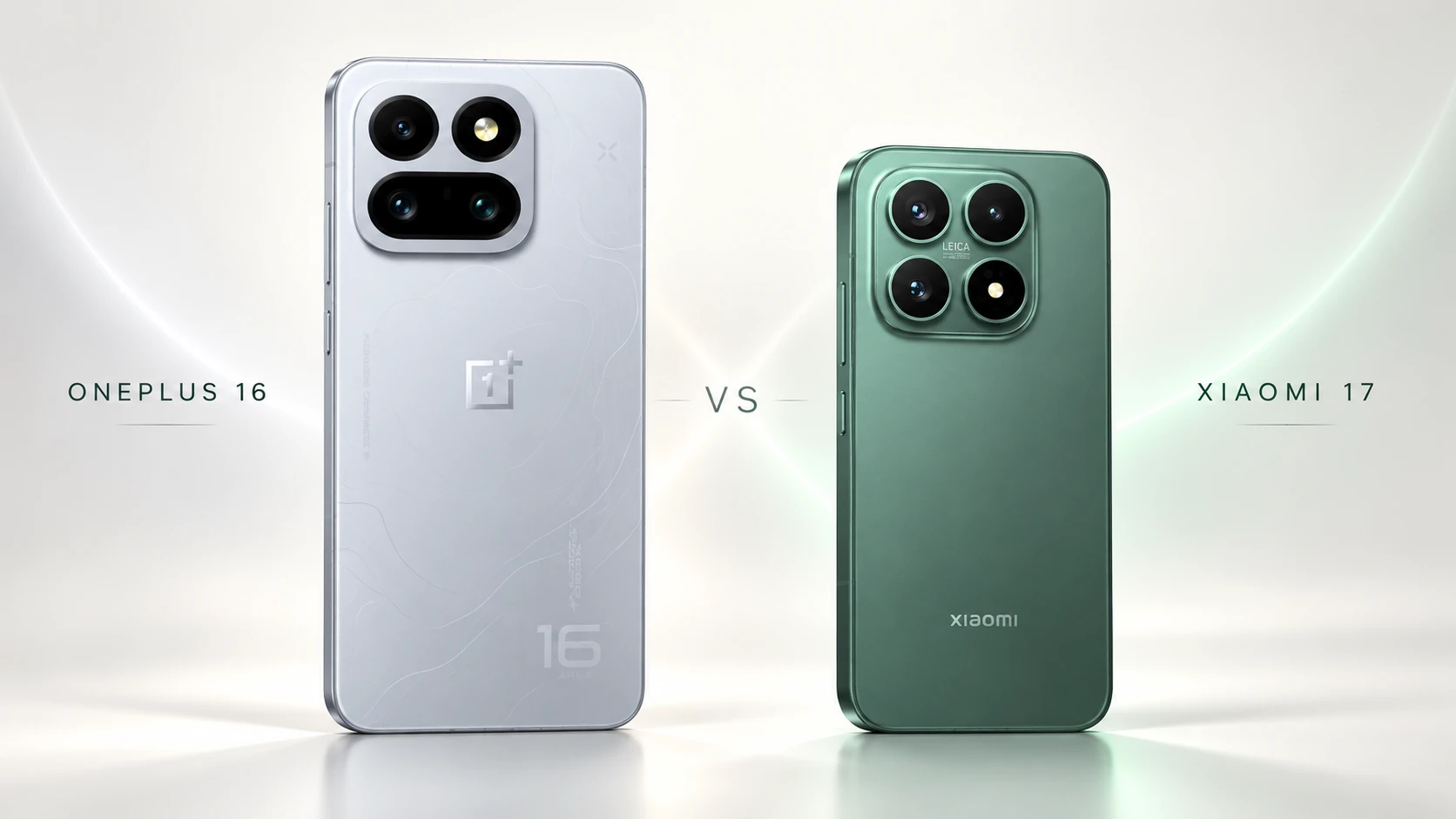
Updated October 28, 2026. OnePlus 16 is the candidate for a buyer prioritizing a larger high-refresh gaming screen and a very large stated battery. Xiaomi 17 is the alternative for someone who wants flagship hardware in a smaller body. There is an important regional distinction: this comparison uses official China specifications for OnePlus and official global specifications for Xiaomi.
Quick comparison
| Feature | OnePlus 16 (China) | Xiaomi 17 (global) |
|---|---|---|
| Display | 6.78-inch; 2772 × 1272 | 6.3-inch; 2656 × 1220 |
| Refresh modes | 1–165Hz outside gaming; up to 185Hz in supported games | 1–120Hz |
| Processor | Snapdragon 8 Elite Extreme Gen 6; 2nm China listing | Snapdragon 8 Elite Gen 5; 3nm |
| Battery, typical | 9000mAh equivalent, dual-cell | 6330mAh |
| Charging maxima | 100W wired; 50W wireless | 100W wired; 50W wireless |
| Main / telephoto | 200MP / 50MP 3x | 50MP / 50MP 60mm-equivalent |
| Weight | Approximately 217–220g | 191g |
| Width | 76.67mm | 71.8mm |
First decide whether an import suits you
OnePlus’s China specification describes ColorOS 17. It does not establish a global OxygenOS model, local availability or identical international services. Before evaluating the attractive hardware, confirm that the exact regional unit supports your carrier and required applications.
Ask the seller about notification behavior, languages, Google services, payment compatibility and warranty support. A global Xiaomi specification is a different purchasing baseline, but it still needs to match the actual model on the listing. Comparing an imported price with a fully supported local price without accounting for those differences can be misleading.
Size: Xiaomi’s strongest everyday argument
Xiaomi’s smaller screen, narrower body and lower weight make it the obvious candidate to try for one-handed use. That is our inference from the dimensions, not a guarantee of comfort. Hand size, case thickness and where you grip the phone all matter.
OnePlus gives you more physical screen space for controls, maps and video. That can be useful during gaming, while making pocket carry and thumb reach less convenient. Try landscape controls and everyday typing before choosing either size.
The rear designs are distinct: OnePlus uses a patterned pale finish in the reference shown, while Xiaomi has a compact square camera area. The cover follows the official devices rather than reusing an older circular-camera OnePlus model.
Gaming: understand what 185Hz actually promises
The OnePlus specification separates its ordinary adaptive refresh range from its highest gaming mode. A supported game and the right software settings are required. A panel capable of refreshing rapidly cannot force every game engine to render at that rate.
The newer OnePlus platform is a reason to examine performance tests, not a basis for inventing a frame-rate lead. Seek results for your exact game at matched graphics, temperature and session length. Also distinguish native rendered frames from any enhancement or interpolation mode.
For players whose titles are capped well below either display maximum, size, heat, touch behavior and battery drain may matter more than the headline refresh number. Xiaomi’s smaller body should also be evaluated during extended play rather than only a short demo.
Battery: capacity is not a stopwatch
OnePlus publishes an equivalent capacity for a dual-cell arrangement. It should not be interpreted as two separate 9000mAh batteries. Xiaomi’s figure here belongs to the global model and should not be replaced with a China-market number from an import listing.
The OnePlus capacity advantage is substantial on paper, but runtime depends on workload, screen settings and network conditions. There is no measured endurance result in this comparison. If you mainly play away from an outlet, prioritize a consistent battery test in your chosen game.
Both list the same wired and wireless charging ceiling. Compatible protocols, chargers and temperature still determine actual power. Equal peak wattage also does not mean equal full-charge time when battery capacity differs.
Cameras: compare framing and reliability
OnePlus’s higher main-camera pixel count does not establish better photographs. Xiaomi’s dedicated telephoto offers a different native framing distance. Compare indoor people, focus reliability and lens switching instead of assuming the higher number wins.
The practical choice is whether the camera performs well enough for your subjects while the rest of the phone fits your life. A gamer who rarely uses telephoto and a traveler who photographs people daily may reasonably reach different conclusions.
Value depends on the whole purchase
Compare the delivered cost, storage, compatible charger, taxes and repair support. For OnePlus, leave room in that calculation for the additional regional checks. Do not assume that every seller’s package matches the official China box contents.
A compact phone can be the better purchase even when it loses a specification contest. Conversely, someone who wants a larger gaming device may accept the added size and import complexity. The value judgment follows the use case.
Which phone should you choose?
Choose OnePlus 16 if supported high-refresh gaming and battery capacity are the priorities, and you have verified the China model’s software, network compatibility and after-sales arrangements.
Choose Xiaomi 17 if compact handling is the priority and you want to compare against its global configuration. For a buyer who has no interest in managing an import, regional support may be the deciding factor.
Read the individual phone guides
Official sources
- OnePlus official China specifications
- OnePlus official design and gaming details
- Xiaomi official global specifications
Method: This is an editorial comparison of published manufacturer specifications, not a hands-on test. Recommendations are our interpretation of the listed features; no benchmark, camera ranking or measured battery result is claimed. Regional models, accessories and software features can differ. The AI-created cover follows official device imagery and is an editorial illustration.